Category Archives: Books

A Nova Scotian island library

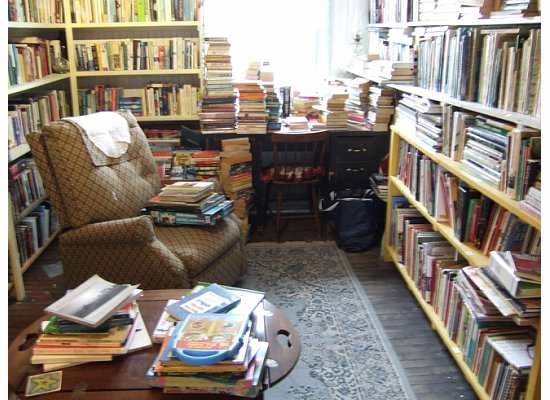
Recent travels took us to an island off the coast of Nova Scotia’s south shore: Tancook Island. The congenial crew member pointed us in the direction of his house, where his wife, Hillary, runs the island museum, art gallery (Wishing Stones), and … library! Books spill out everywhere in this charming spot, as well as shelves full of videos, magazines, board games, and puzzles. There were comfortable chairs and couches to relax in, and a wood stove to keep warm by in the colder months.

Hillary started the library with her own books, but once the word got out that there was a library on the island books began to appear. She connected with the South Shore public library system, which offers a rotating selection of books and videos through a bookmobile that comes to Chester, the town on the mainland which the ferry from Tancook connects to.

Hillary doesn’t bother with a check out system – instead, she trusts the islanders to return the books in a timely manner, and they do! Overall, Hillary provides a comfortable gathering place on Tancook Island, where anyone in the community of about 100 souls (in the winter) is welcome to hang out, knit, visit, and read.

For more on Tancook’s library see: http://www.wishingstonesgallery.com/9322.html

On the Death of a Husband

By Nancy Jordan.
Quite by accident, I recently checked out two books from the library on death and dying, to be more exact, on husbands dying.  The one published in 2007, I stumbled upon when I was shelving other books.  I liked the title, the End of the Alphabet, and the cover, so I put it in my ‘to check out’ pile.  Later that morning, I noticed someone had put a book out for display that I had been meaning to read: I Married you for Happiness.  I didn’t remember the subject, I just remembered it was on my mental ‘to read’ list.  So I checked both books out and brought them home.

I started with ‘The End of the Alphabet’ by C.S. Richardson.  It’s a novel about Ambrose Zephyr who has always made lists to organize his life.  His lists are always not only alphabetical, but in alphabetical terms.  The more exotic ones favor places or animals most people have not heard of.  He is diagnosed, at age 50, with an unnamed disease and told he has 30 days to live.  His reaction:  make an alphabetic list of the 26 things he wants to do in those 30 days (luckily, he sighs, the alphabet is only 26 letters long, giving him a few extra days), all involving geographic places.  His wife, Zappora Ashkenazi,  reacts somewhat differently.  In the doctor’s office, she wonders why her body has seemed to stop working, why the doctor sounds like he’s under water.  She imagines them at home, preparing a meal for friends, imagining that this is not happening.

They are off:  to Amsterdam to see a painting he’d always wondered about; to Berlin to follow memories of Uncle Jack; to Chartres.  Zappora wonders why not Paris, if Paris they could stay there and stop this already mad dash from place to place.  Through their travels, the reader learns snippets of the couple’s history and romance, the disagreements, the tender moments.   Zephyr becomes weaker, more insistent, Zappora becomes more introspective, less calm, begins to panic.   They make it to Istanbul, then agree to go home to London, Kensington Park where they sit on a bench and talk about the next places in the alphabet, where they’d been and their memories there.  The ending is sad, but warm, based on the reader’s understanding of the strength of their relationship

A very interesting and uniquely written book, not like the usual ones I have read, but I was glad to have read it.

Next I started the novel ‘I married you for Happiness’ by Lily Tuck that recounts the last 12 hours Nina spends with her husband of 43 years.  But in this book, Philip has already died.  He came home and said he was going to lie down for a few minutes before dinner.  Nina calls him when dinner is ready, but there is no answer.  When she investigates why he didn’t show, Nina finds him lying peacefully on his back, not moving.  She crawls into bed with him, and thus begins her 12 hours of reminiscing of their years of marriage.  He was a physicist, obsessed with numbers, sees life through the mystery of numbers.  She is an artist, remembering their life together through that lens.  Throughout the memories, she comes back to the night, his cold body, thoughts of what she has to do in the morning, what her life will be like.  As dawn breaks, she feels his spirit leave the room.

In spite of wondering why, of all books, I was drawn to these two, the pair together created a new reading experience for me.  For anyone who wants to read these, and then continue the experience, there is also a memoir by Joan Didion “A Year of Magical Thinking” and another by Kate Braestrup, “Here when you need me’, both different totally different ways of coping with a husband’s death from the widow’s point of view.  Now I’m wondering where are the books on the experience of a wife’s death from the husband’s point of view?  The only ones I can think of are  Julia Glass’s, “The Widower’, and Helen Simonson’s “Major Pettigrew’s Last Stand”.  The prospective is different however: both of these deal with the husband’s progress through life after the death.

College administrators turned mystery writers

What do college administrators in Maine do after they retire? Well, apparently a few turn to writing mystery novels that take place in small towns.

William D. Andrews, former president of Westbrook College, had turned out two mystery novels (“Stealing history” and “Breaking ground”) that take place in a fictional town in Western Maine (appears to be based on Bethel), with the Julie Williamson, the director of the historical society, as the protaganist.

Earl H. Smith is a retired dean of Colby College. His first book came out last year: “The Dam Committee” also takes place in a small town, based in the Belgrade Lakes Area. It  brings to light the politics and eccentricities of town committee and community folks. And yes, there is a dead body!

Anyone who lives in a small town will recognize some of the character types in these books. The Long Island Community Library carries “Stealing History” and “The Dam Committee,” examples of what retired academics do with a little more time on their hands.

Winter reading on Long Island

Winter is here! Well, at least according to Casco Bay Lines. My heart always drops to see the cold blue color of the winter schedule, which runs from October through April. Yes, winter is 6 months long in Casco Bay! Well, us book lovers make the best of it and anticipate spending the dark evenings sitting by the fire, reading all those long tomes we put off during the other more inclement and lighter months, perhaps that Moby Dick or Gone with the Wind that we’ve been waiting for a “rainy day” to read (i.e., snow, sleet, hail, or whatever the gods bring us). And thanks to the longer check-out period that the Long Island Community Library is hoping to set into motion soon (from 2 weeks to 3 weeks), we will now have more time to read the wonderful selection of library books offered by our own island library. So, now that “winter” is here, it’s time to head to the library, and stock up on your favorite authors, as well as the wonderful array of films that are waiting to be viewed (including the recently viewed movies shown at our foreign film night). Enjoy!

More special libraries in Portland to investigate

A few months ago I wrote about the Maine Charitable Mechanics Association Library, as well as the Maine Irish Heritage Center Library – both of which are elegant destinations in and of themselves, let alone the books they hold. Here are a few more libraries to investigate:

The Greater Portland Landmarks Frances W. Peabody Library is located at 93 High Street, in the Stafford House. The GPL library is the “only library specializing in architecture, preservation, and restoration.” The staff is dedicated to making the collection of books and magazines on architecture, home improvement, and preservation a useful resource to members of the Landmarks, as well as researchers interested in the history of their house and neighborhood.

If art is your thing, the Maine College of Art’s Joanne Waxman Library on Congress Street has the best view and sunshine in which to relax and read. Although you have to be a student or own a library card to check books out, Library Director Moira Steven welcomes folks in the community to just enjoy reading, in this large open modern library, the numerous art books and periodicals that she has available. Moira says, “We have approximately 30,000 titles and 100 journal subscriptions, 85{a924d0e49cc5813a40c6e5abf88cc5a144f266a1cd8c3074f66db425794a7bb6} of which are art-related. Our Special Collections room holds over 500 titles, many of them examples of Victoria printing and binding as well as an artist book collection of over 150 titles.  We hold exhibitions of student and community art and thematic displays of art and design titles throughout the academic year.”

If your interests lean towards religion and spirituality, Portland is most fortunate to have the Bangor Theological Seminary General Theological Library. This library is in the same building as the State Street Church offices, just up the street from the Maine Irish Heritage Center. (Go upstairs for the church office, and downstairs for the Seminary offices, classrooms, and library). Librarian Laurie McQuarrie is available to help you navigate your way through their collections of theological books and periodicals. While their primary mission is to serve their faculty and students, the public is welcome to use the library. Sadly, though, this library will no longer be with us after next summer, as Bangor Theological Seminary will no longer be granting degrees, thus no library. So, visit this library while you can.

So, if art, architecture, and religion is your thing, these three downtown Portland libraries offer wonderful resources, including books to absorb and relish.

Bennett’s Island Trilogy revisited

Some of you know my story – how I came to live on an island. It goes something like this: “years ago, when I was living in California, I came across Elisabeth Ogilvie’s novels about an island off the coast of Maine, and the families that lived there. When I read these books, I thought ‘someday I want to live on an island in Maine.'” Now I’m fortunate enough to call Long Island home, so when I reread these books, do they still hold the .same magic for me? I’m happy to say that they still do. I just finished rereading the third in the trilogy, which consists of High Tide at Noon (1944), The Storm Tide (1945), The Ebb Tide (1947). Ogilvie contined to write about the characters well beyond the initial trilogy, for about 50 years, but these first three books are the ones that really captured my imagination with their descriptions, voice, plots, and characters.

Winter Weekend 2013: Great Expectations by Charles Dickens

Something to look forward to this winter…

On the 200th anniversary of Charles Dickens’s birth, the Maine Humanities Council is delighted to announce our first Dickens novel for Winter Weekend. Great Expectations, one of Dickens’s mature novels, is replete with his trademark colorful characters and biting criticism of society. This bildungsroman is a powerful and dramatic story from Dickens at his prime.

Winter Weekend is a humanities experience that, though lectures and discussions, unites historians, writers, artists, public intellectuals, and others to help us understand each year’s book in its rich historical and cultural context.

Winter Weekend 2013 will take place March 8 and 9 at Bowdoin College in Brunswick. The $225 registration fee includes a copy of the book, background readings, a reception, dinner, lunch, and coffee. CEUs are available for teachers. Limited scholarships are available for college and high school students. The program starts at 5 p.m. on Friday and continues until mid-afternoon on Saturday.

To register, visit http://mainehumanities.org/programs/2013.html

The Red Dory – A Long Island Book

The Red Dory –  a Long Island Book

by Chris McDuffie

It is not only the new books in our library which are interesting. I signed out The Red Dory by Hazel Wilson recently because I knew its author had spent a lot of time in her family’s cottage next to ours in Beach Cove, the one now owned by her grand nephew Greg Brown. Hazel Wilson published about 20 books, mostly for young readers, and The Red Dory was her first, published in 1939. It presents the summer adventures of a boy, Donald, living with his grandparents on Long Island.

In this book Wilson changed the name of Long Island to Pine Island, but there is no doubt as to the real location when she talks of Harbor de Grace where Donald lives, catching a lobster thief off the Stepping Stones, and taking summer people fishing off Outer Green Island.

Pasted in the back of the library’s copy there is a note from Hazel Wilson to a Mrs. Hewey which says, “The old captain in the book is partly modelled after Captain Ben Woodbury, whom I knew as a child. None of the happenings are really true, but his character was kind and dignified as I made Captain Eben in my book.”

The “happenings” (like the day a swordfish takes Donald and his red dory for a “Nantucket sleigh ride”) are things she may have made up to appeal to her young readers, but the book is so rich in details about the lean circumstances of a fishing family on Long Island in the 1930s that I think anyone who loves Long Island, as Hazel Wilson did, will find this a fascinating read.

There’s another Hazel Wilson book at the library, Island Summer, and again it is set on Pine Island (Long Island to those of us in the know). That’s going to be my next read.

The Maine Garden Journal

For those of you who missed the talk at the beginning of this summer’s Long Island garden tour by Lisa Colburn, you will have another opportunity upcoming, at Portland Public Library’s Local Author’s Lecture Series on Friday, August 31st, at noon. Lisa’s book is subtitled: Insider  secrets  from  Maine  people  who  love  to  put  their  hands  in  the  dirt.

For more information on Lisa and her book, check out her website: http://www.mainegardenjournal.com/


Expansion project records – documenting our history

10 years ago our library was in the midst of a major expansion project, which allowed us to move our tiny library collection from the cramped and dark basement area of the school, into a glorious new space full of light and color. Thanks to the hard work of the building committee, ably led by our current library director, Nancy Jordan, this space, which not only includes a library, but also an art gallery, meeting space, multi-purpose room, meeting room, and computer room, is now open 7 days a week. Architect Frank Oliva designed our beautiful new building, which was completed in 2004. spring on Long Island 9

Nancy Jordan recently donated the records of the project to the Long Island Historical Society, and they are now processed and available for researchers. This collection (1.5 linear ft.) is an excellent documentation of a construction project, and includes correspondence, documents, invoices, newspaper clippings, photographs, and minutes. Major parts of the collection are regarding not only the construction, but the fundraising and grants applied for. It’s truly evidence of what can be done with a lot of determination and fortitude.