Exciting news! After several years of not having a book group at the Long Island Community Library, a new group is up and running! Started by “the two Lindas,” Linda Greene and Linda McCann, we meet the 2nd Monday of each month at 1 p.m. Our initial meeting last November brought together a group of enthusiastic islanders, full of ideas and suggestions about books to read and how to proceed. We started with The wind in my hair : my fight for freedom in modern Iran, by Masih Alinejad with Kambiz Foroohar (her husband). Following that we read Dinners with Ruth: A Memoir on the Power of Friendships, by Nina Totenburg of NPR, about her friendships, including with Supreme Court Justice Ruth Bader Ginsberg. Following two books by journalists, we are turning to fiction, with Americanah by Chimamanda Ngozi Adichie. Our next choice for March is by a Maine author: The Midcoast, by Adam White.
This is a great way to get to know your fellow islanders on a deeper level, sharing our love for good books. All are welcome!
According to Goodreads, last year I read 49 books! The shortest book at 112 pages was Discover Galway, by Paul Walsh, which I read when I thought we may be going to Galway, Ireland (didn’t happen last year, but would still love to go). The longest book was by the same author as the longest book I read the previous year: Dragonfly in Amber, by Diana Gabaldon – her second book in her Scottish Highlander series, “Outlander,” at even longer than her first one, at 947 pages (way too long, so we’ll see if I’m inspired to read her third book this year). The most popular book was “The silent patient” by Alex Michaelides, which was read by at least 2,604,312 people on Goodreads. The least popular (read) book was Discovery Galway again (sorry Paul Walsh), which was on only 5 shelves of Goodreads readers.
Amongst those 50 or so books that I read in 2022, here are some that I would recommend reading:
Sailing true north: ten admirals and the voyage of character, by Admiral James Stavridis. Calvin College in Grand Rapids, Michigan (which I attended for one year) sponsors a lecture series, called “The January Series.” I was able to catch some of the lectures online, including one by Admiral James Stavridis. I was so enchanted by his charisma that I sought out (i.e., purchased) several of his books for Michael. We enjoyed his writing and learned a lot about various admirals throughout history. Now we are reading his “Sailor’s bookshelf: fifty books to know the sea.” Some of the books we’ve read before, but he’s introducing us to more that are now on our “to read” list of “boat books.”
The Violin conspiracy: a novel, by Brendan Slocumb. Two years ago, in the midst of the pandemic, I picked up the violin (a lifelong dream), and have really enjoyed playing it (albeit still pretty badly). So, when I saw this title, I knew I had to read it. After the initial chapters, I checked the author bio, as it seemed like whoever wrote this had to be a musician. That was my favorite part of the book, the descriptions of Ray playing the violin. You could feel his passion. I also liked Ray’s story, of falling in love with the violin, and his challenges along the way (especially standing up to racism). This first novel is based somewhat on the experiences of the author (without the “conspiracy,” which while interesting, was not as compelling as the other parts).
My Story, by Mohammed bin Rashid Al Maktoum. “My sister went to Abu Dhabi, and all she bought me was…” this amazing book by the Prime Minister of the United Arab Emirates. Michael and I read a chapter each evening and agreed that this should be required reading for world leaders, or anyone interested in the politics of the Middle East. How refreshing to read about someplace in the Middle East that is not fraught with war and corruption. The chapters are deliciously short, well written, and interesting. The author spends a bit of time talking about his mother and his horses, but his wife gets only one brief mention (later I found out why – he’s not so great on the women in his life, aside from his mother). Overall, we were very impressed with this man, and his poetic soul and leadership.
Wintering: The power of rest and retreat in difficult times, by Katherine May. Okay, I admit it, I was a sucker for the beautiful cover, as well as the great title. While not all of this book grabbed me, there was so much that I felt like I would carry forward. I do at times feel like I am wintering – not only on the calendar, but with other factors in my life, including the pandemic. And I do admit to loving winter, although it can be challenging. I liked the approach of writing the book in monthly segments, and I also liked that the author is British and her home is in a seaside village. Katherine May intertwines her personal stories with experiences of other places and people and creatures. Her admission that this book turned out differently than she intended is quite true to life – despite our best intentions, life happens.
The bookshop of second chances: a novel, by Jackie Fraser. This is my kind of book – great setting, lovely characters, good story (even though predictable ending, which is just fine with me). I loved Thea and her wonderful honesty and introspection, as well as Edward and his curmudgeness (not a word, I know). And who can resist, in general, books where people escape their lives and start over in a small idyllic village somewhere – in this case in Scotland. And working in a bookstore! What could be better, indeed.
Wanderlost: Falling from grace and finding mercy in all the wrong places, by Natalie Toon Patton. I went on a spending spree at my favorite publisher, Paraclete Books, and this is one of the titles that intrigued me – I thought my friend Elizabeth may like it, as she is a spiritual soul who loves to travel. Of course, I had to read it first – and loved it! What an inspiring story, and so beautifully written (and very funny!). There is much here to chew on, and reread. Like the author, I’m also intrigued by the intersection of travel and spirituality. I loved how Natalie’s perceptions changed with her exposure to different cultures and faiths and people. I think that happens to some of us, whose faith evolves throughout life, and what we are drawn to (such as Celtic Christianity for me). Church and religion can disappoint us (reading “Jesus and John Wayne” the previous year was a real eye opener), and we peel away the layers we try to find what remains true.
Finding Dora Maar: An artist, an address book, a life, by Brigitte Benkemoun. I read about this book, in which the author finds an address book that she eventually realizes belonged to artist Dora Marr (1907-1997), in one of the magazines lying around our staff kitchen. It looked so interesting that I suggested it for my book group. I am so glad I read it – it’s right up my alley in so many ways. As an archivist I am always trying to puzzle items out – so I loved that aspect of the book. I also find that whole era of these 20th century French artists and writers fascinating. I had heard of some of the people in the book, but it was fun to learn about them all on a deeper level, and Dora’s relationship with them.
The Lost Apothecary: a novel, by Sarah Penner. This impressive and well written first novel, about a female apothecary in London who secretly dispenses poisons to liberate women from the men who have wronged them, is a fun and fast read, with three different voices telling the story, in two different time periods. Yes, this seems to be a common way to tell historical fiction these days, which sometimes works and sometimes doesn’t. For the most part this does work, and I found myself interested in the two stories, and caring about the women. The contemporary story of a marriage is also compelling, about how one can lose themselves in expectations and doing the “right” thing.
The Cottage Fairy Companion: A Cottagecore guide to slow living, connecting to nature, and becoming enchanted again, by Paola Merrill. A friend introduced me to the Cottage Fairy videos on YouTube, and I found myself falling into Paola’s beautiful world in a rural valley in Washington State. When I was on vacation in Rockland, Maine, I found a copy in a local bookstore, and purchased it. It’s the kind of book where you can read a few pages at a time, and just savor the good writing and beautiful photographs. Paola Merrill is an old soul, and is so thoughtful and sensitive about how she approaches life. I love how she grows as a person throughout her videos, and in her book. She also has a puckish sense of humor, and is a unique and honest individual. Having watched her videos for the past year or so I can hear her voice when I read her book. I like how the book is laid out in seasons, too, with various recipes to try.
This Year It Will Be Different, and other stories: a Christmas treasury, by Maeve Binchy. By the time Christmas rolls around I’m in the mood for light reading, especially Christmas stories. This book came into my hands at the perfect time, as I had been reading a lot of more serious books. The short stories were so readable, and while I liked some of them better than others, overall they were very enjoyable. They had a bit of depth to them, and not always the happy endings that one would imagine.
This month, in the midst of celebrating a Celtic Christmas, Evergreen United Methodist Church, on our fair island, was honored to host Abraham Schechter, the Special Collections Librarian at the Portland Public Library, and his wife Angelika, who shared with us about Christmas in Wales, as seen through the eyes of Dylan Thomas, the famed Welsh poet. After reading to us, “A Child’s Christmas in Wales,” Abraham showed us photographs of Swansea and Thomas’ home, where Abraham was fortunate enough to be the writer-in-residence at Dylan Thomas’ home. (At another point, Abraham spent some time at The Kilns, the home of C.S. Lewis in England, so he is indeed a man blessed to live amongst the homes of these two amazing literary men). One can also visit Dylan Thomas’s boathouse, including enjoying tea on the Taf Estuary.
Last month I had the wonderful experience of visiting Jane Austen’s home in Chawton, England, in Hampshire. Her house is on the main street in the little village of Chawton, and it was a lovely autumn day for wandering throughout her home, with costumes from recent Jane Austen films interspersed throughout the rooms. One room had an exhibit about “Jane Austen in love.” I especially loved seeing the colorful wallpaper, with shades of yellow and green, throughout the house. Outside of the house was a peaceful garden, as well as a wonderful gift shop, full of books, tea, fudge, ornaments, and even Jane Austen ducks!
We ate lunch across the street at “Cassandra’s Cup,” named after Jane’s sister Cassandra, which had teacups hanging from the ceiling, and a delicious variety of paninis.
From there we strolled up the street to Chawton House, which was owned by Jane’s brother Edward.
“Lucky Edward” was adopted into the Knight family, relatives of Jane’s family. Jane and her mother and sister often visited Edward at Chawton House, and they attended the little church nearby, St. Nicholas Church. Jane’s mother and sister are buried in the church yard there.
Chawton House houses the research library of The Centre for the Study of Early Women’s Writing, 1600–1830, using the building’s connection with Jane Austen. While we were at the house, there was a wonderful exhibit about women travel writers.
While I can’t claim to have read all of Jane Austen’s books, it was wonderful to delve into her life, and learn a lot more about this amazing woman writer, who is one of the best known and loved authors of all times.
Most public libraries in Maine have a Maine collection – books about Maine, and books by Maine authors. My guess is few of them have as nice of a reading nook as our island library has – two comfy chairs and reading lamps in a cozy little alcove, where one can leisurely explore all sorts of books about our beloved state. The Long Island Community Library has a wonderful selection of Maine books, including fiction, non-fiction, biographies, and children’s books.
Our books range from obscure authors to more famous authors, such as classic authors (Sarah Orne Jewett, Elisabeth Ogilvie, Kenneth Roberts, Booth Tarkington, Edna St. Vincent Millay, Robert Peter Tristram Coffin, Louise Dickinson Rich, Gladys Hasty Carroll, Mary Ellen Chase, Ruth Moore, May Sarton, Ben Ames-Williams, Henry Beston, E. B. White) and contemporary authors (Stephen King, Paul Doiron, Cathie Pelletier, Carolyn Chute, Tess Gerritson, Charlotte MacLeod, Richard Russo, Elizabeth Strout, Julia Spencer-Fleming, Monica Wood). We also have Long Island authors, such as Alix Kates Shulman, Peter Kilgore, and Dorothy Herbert.
Our children’s books authors and illustrators include Margaret Wise Brown, Ashley Bryan, Barbara Cooney, Robert McCloskey, and many other classic authors and contemporary.
Non-fiction subjects include maritime/nautical/sailing, environmental, flora and fauna/gardening, cookbooks, art, crafts (knitting, rug hooking, etc.), poetry, and history.
We also have a nice collection of more ephemeral materials related to local history, including Long Island.
So, next time you are at our island library, take a minute to peruse the shelves in our nook, and perhaps sit in a rocking chair to enjoy a bit of Maine.
Some of you may be familiar with the beginning of a poem by Rachel Field, “If once you have slept on an island, You’ll never be quite the same.” I recently read a book about this Maine woman writer, that allowed me learn more about Rachel Field’s life, including her life on her beloved Sutton Island. The Field House: A Writer’s Life Lost and Found on an Island in Maine by Robin Clifford Wood, dispelled my false notion of Rachel Field being a sweet little old lady in a rocking chair knitting. Obviously I knew nothing about her, but that must be my impression of some of these Maine women writers, especially those who wrote children’s books. The real Rachel Field (1894-1942) was a sophisticated cultured woman who actually spent more time in New York City and California than at her Maine island home. And sadly, although she was sweet, she didn’t live long enough to be old (and she didn’t appear to be little). Now when I see one of her books, or hear the familiar phrase, “If once you have slept on an island…” I will have a different picture in my head of Rachel Field.
Aside from the Maine woman writer aspect, which I always enjoy learning about, I liked this book for the dual story – the thread between Rachel and the author, with the island home of Rachel Field tying them together. What a treasure for Robin to live in the home of this author, to really absorb her history, and to be enchanted enough to feel the call to write her biography. Truly a labor of love. I liked reading Robin’s letters to Rachel – you can feel the emotion. And I enjoyed reading about Robin’s research and visiting sites related to Rachel.
Rachel Field is best known for the Newbery Award–winning Hitty, Her First Hundred Years. I finally read this book several years ago, and liked it so much that it made my top 10 books read in 2018. Several of her books were made into movies. She was quite prolific, writing novels, non-fiction, poetry, and drama.
For those of us who are not only lucky enough to be able to sleep on an island, but to live on an island, Rachel Field is worth a second look.
We’re back! After a several year hiatus, Art and Soul is back – on Saturday, July 16th. Come shop at the used book sale, delight over baked goods, bid on that piece of artwork that will go in that perfect space on your wall, and purchase a raffle ticket for one of our beautiful baskets. We even have Beanie babies for sale! We are working hard getting the library ready for a busy day.
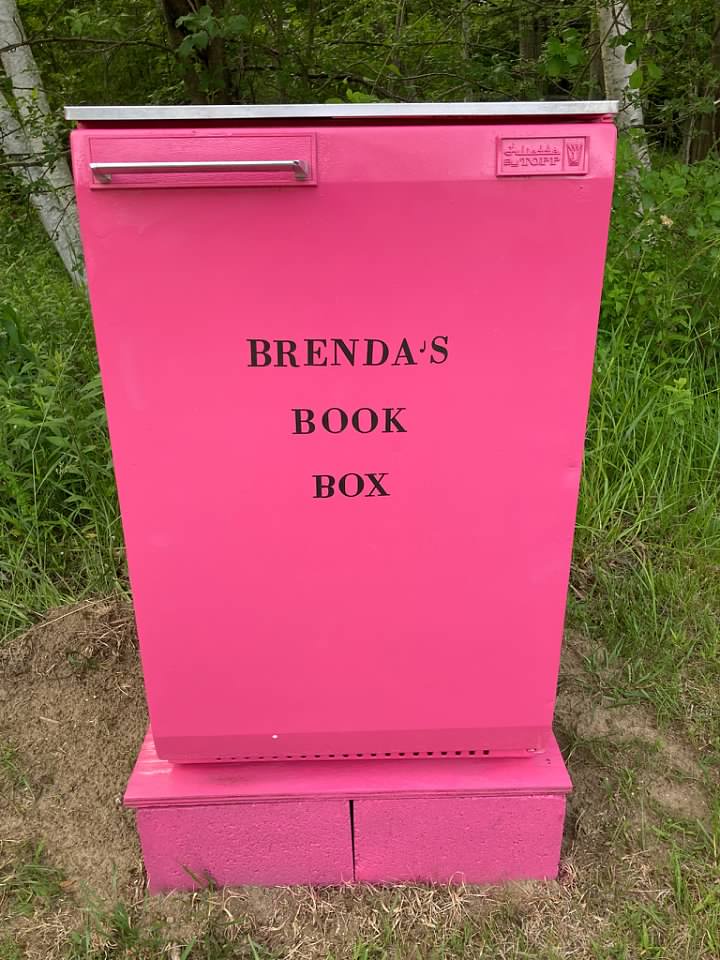
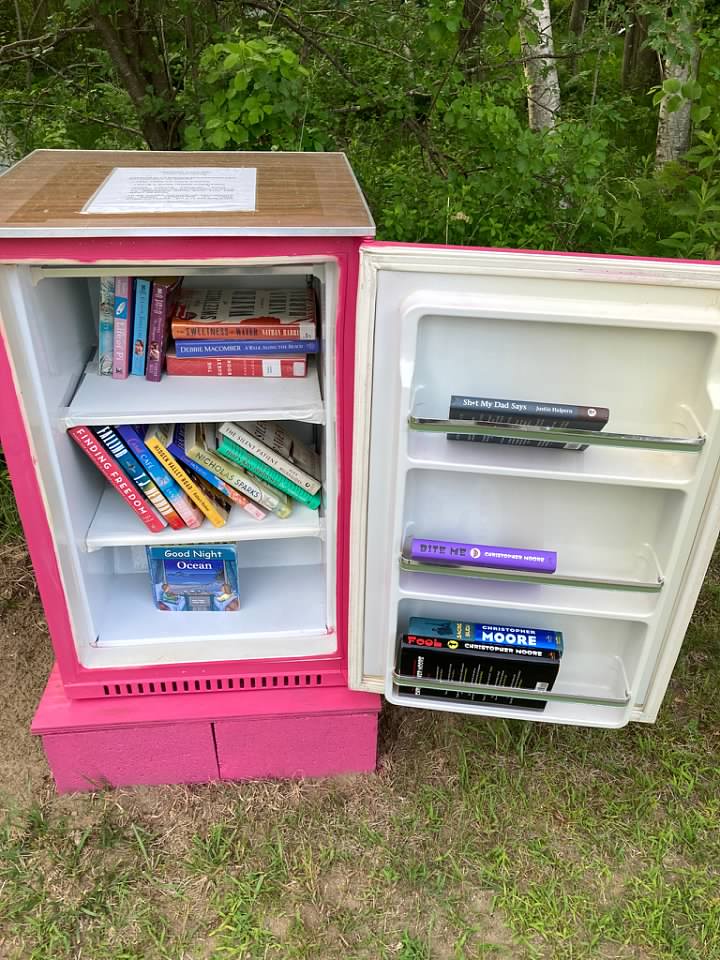
What a wonderful place we live! Long Island now has a new outlet for books, sort of like a “Little Free Library.” In this case it’s a pink painted refrigerator, called “Brenda’s Book Box.” Located at 604 Fern Ave., this little library was lovingly made by Brenda’s husband Dave.
Brenda’s mission is to encourage reading and exchanging of books:
➢ FEEL FREE TO TAKE A BOOK
➢ LEAVE A BOOK (GOOD CONDITION)
➢ WHEN YOU’VE FINISHED BOOK – PLEASE PASS ON OR RETURN IT BACK TO “BRENDA’S BOOK BOX” FOR THE NEXT READER
➢ I’D BE HAPPY TO PICK UP ANY BOOKS IN GOOD CONDITION AT YOUR HOME/COTTAGE – MY # IS 207-650-5354
So, next time you are out for a walk, be sure to bring a book to swap… at Brenda’s Book Box!
This month I celebrate 10 years of writing blogs for the Long Island Community Library – it’s been a joy and a privilege, and allows me an opportunity to blog about subjects near and dear to my heart, including our island library, books, and reading.
The posts are a variety – some just share information, and some are more thoughtful and original. We love having guest bloggers, such as when Lorinda Valls wrote about a trip to Monroeville, Alabama, home of Harper Lee, and Nancy Jordan wrote about the theme of “death of a husband” in literature.
At one point I began an annual blog in January about favorite or notable books that I enjoyed reading in the previous year. An occasional series I started was about authors on the bay, including Dr. Chuck Radis and Kim MacIsaac on Peaks Island, Stephen English and Anne Weber on Great Diamond Island, and our own Charlie Adams.
Various topics caught my interest over the past 10 years, such as books about coffee and tea, and books about Scotland, Ireland, Australia, The West, and Daphne DuMaurier’s Cornwall. Other topics related to literature included books and films about game wardens, pandemics, gardening, world religion, cats, poetry, bicycling, travel, knitting, pilgrimages, war, autism, food (memoirs), mobile librarians, orphans, booksellers, and porches. Even “Famous men’s wives and lovers in literature” found its way into the blog. I explored topics related to books: Little Free Libraries, book clubs in Portland, Maine authors and poets (Ben Ames Williams, Harriet Beecher Stowe, Richard Blanco, E.B. White), seed libraries, Goodreads, and a few blogs about accessing books during Covid, when we were sadly without our usual access to favorite libraries and bookstores.
I wrote about island libraries in Casco Bay (Chebeague, Cliff, Peaks, the Diamond Islands) and beyond (Matinicus). I wrote about libraries in Portland that can be walked to from the ferry, and libraries I encountered on my vacations, including in the Adirondacks and Nova Scotia. I profiled our own library’s programs, including our major fundraiser: Art and Soul.
I was able to highlight our exhibits in the small meeting room case, including exhibits about rocks, birds, Long Islanders (publication of the Long Island Civic Association), the history of our island library, the history of photography, Portland pottery, record albums, the Bunny Hop, Anne Kilham cards, Beanie babies, first ladies, fans and valentines, cookbooks, and plates of barns. At Christmas we often had special holiday exhibits about cookie cutters, snowmen, Santa’s Village, Christmas ornaments and decorations, Advent calendars, a ceramic nativity set, often highlighting items made by or collected by islanders.
Some of my more esoteric topics include “Which is better, the book or the movie?,” revisiting classic books, and common themes in books.
Curt Murley set up the WordPress site for blogging in May of 2012, and contributed the first blog about the library used books table – a few days later was my first blog about films that take place in Paris. I’m not exactly sure how it came about that I volunteered to write the blogs. I seem to recall Maggie Carle, in our library board meeting when we first talked about writing blogs for the library website, saying how difficult it is to keep blogs going – so I’m very pleased that I’ve been inspired to write about something every month for the past ten years. Many thanks to the faithful few who actually read these blogs – I hope you enjoyed reading them as much as I enjoyed writing them!
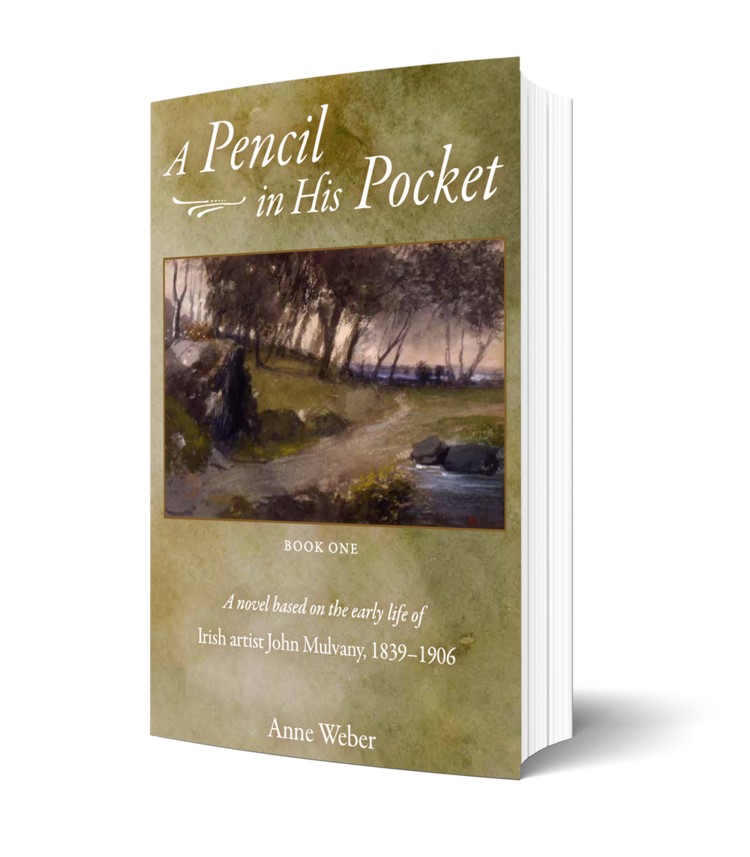
This month, in honor of Irish-American Heritage Month, we welcome Anne Weber of Great Diamond Island back to our blog post. Anne recently published her first novel, A Pencil in His Pocket, about her great grand uncle, John Mulvany, who immigrated from Ireland in 1851 and ultimately became a well known artist of the American west.
Anne kindly responded to my questions about her new book, as well as her personal connection.
How exactly are you related to John Mulvany? (which of his siblings do you descend from?) John Mulvany is my great grand uncle. His half sister, Alice O’Brien, is my great grandmother
How did you balance the few known facts about John with the fictional aspect of telling a good story? The facts became the foundation for the story, i.e. I knew John worked on the Erie Canal as a tow boy, but not how he ended up there, what boat he worked on, who he met, etc. So after researching the Canal for this time period, I used what I learned to write the story so John could learn what would make him the man he became – deeply connected to Irish freedom and an artist. The same thing holds for how John came to America in 1851. Despite all my research, I could not find a record of his entering this country legally. So I created the Duffy family and Eamon O’Rielly.
Where did you find good historical resources of information about John Mulvany, as well as general history, such as about his home in Ireland, his family, his immigration to America, and his time on the canal? In 1985, I began with a genealogy search which connected me with contemporary cousins in Ireland. In 1987, I was invited to visit Moynalty, Ireland where the Mulvany family still lives. The cousins have been invaluable to uncovering verifiable information. And then, of course, came the stories. I visited the Erie Canal Museum in Syracuse, NY for a first hand look; I spend hours reading. The internet might give me direction but the libraries were/are the best place to get the books to verify. Roy Finch’s The Story of the New York State Canals, Richard Garrity’s Canal Boatman, My Life on Upstate Waterways,and Lionel Wyld’sBoaters and Broomsticks were very helpful.
You are an artist – how does your work relate to the artwork of John Mulvany? (how is it similar, how is it different?) What do you admire most about his work, from an artists’ point of view? My art work is a different style and genre. John Mulvany was a man of his time; portraits and history painting. He created three dimensional objects using light and dark. I use the temperature of color to create space; warm and cool colors. As I’ve learned what it takes to sustain a career in the arts, I really appreciate his persistence and dedication. He sketched a picture of a newsboy selling papers two weeks before his death. That picture is lost.
What do you think John would think of your book? If you could sit down in a conversation with him what are some of the big questions you would ask him? I hope he would think the book was a good effort. I would ask him where he stored his paintings at the end of his life; what arrangements he made for “Anarchists”, and his Civil War paintings. What did happen the last night of his life? What were his regrets? Why did he switch subject matter – from Western to Irish. “Preliminary Trial of a Horse Thief” and “Custer’s Last Rally” had made his reputation and then he turned to Irish themes; i.e. “The Battle of Aughrim” which was found in a flea market, sold on eBay in 2010 for over $200,000.
A Pencil in his Pocket is Book One of a series about John Mulvany. For more information about Anne and how to purchase this book, see https://anneweber.me/. Anne will also be speaking about her book at the Maine Irish Heritage Center on April 24th, at 2:00 p.m.
A small library on an island on the coast of Maine